Showing posts with label tomato. Show all posts
Showing posts with label tomato. Show all posts
Tuesday, 29 May 2018
Mixing
The thought of mixing can make the heart sink or lift depending on the skills of the mixer. Pineapple and cottage cheese; potato salad and hard boiled egg; clotted cream and fudge; the thought of all of these, you might think surprisingly, at best cause indifference and, at worst, repel me. But other mixes interest me enormously. Baking meat into pastry. Scraping the residue of a tomato salad - chopped onion, tomato pips, olive oil and the tomatoey juices - into a saucepan of just drained pasta or into gazpacho.

Authenticity
It is possible to be a little obsessive about authenticity. Those obsessives who assert, for instance, that cappuccino should never be drunk after 11 in the morning. Or that cheese and fish do not go together.
I have no difficulty with people putting into a meal whatever ingredients give them pleasure ... but my hackles are raised if someone asserts that it is a particular dish when it is in fact something possibly delicious but completely different. Quiche Lorraine, for example, should have double cream, eggs and bacon. Not cheese. Not onions. And Elizabeth David says so.
I feel the same way about Tricolore. Tomato, mozzarella and basil. NOT avocado, which is perfectly pleasant but is not an ingredient of Tricolore and does not go particularly well with mozzarella. As I was writing this, I mentioned I was writing about Tricolore and, immediately, the enquirer said: “Mozzarella, tomato and avocado?”
But on the subject of avocado, there is, in my view, no one authentic way of making guacamole. And the same is true of gazpacho - which does not even have to have tomatoes in it. Indeed, given that it came into existence long before the Spaniards sailed for the New World and discovered tomatoes in the process, some might say that tomato in gazpacho is inauthentic.
I have no difficulty with people putting into a meal whatever ingredients give them pleasure ... but my hackles are raised if someone asserts that it is a particular dish when it is in fact something possibly delicious but completely different. Quiche Lorraine, for example, should have double cream, eggs and bacon. Not cheese. Not onions. And Elizabeth David says so.
I feel the same way about Tricolore. Tomato, mozzarella and basil. NOT avocado, which is perfectly pleasant but is not an ingredient of Tricolore and does not go particularly well with mozzarella. As I was writing this, I mentioned I was writing about Tricolore and, immediately, the enquirer said: “Mozzarella, tomato and avocado?”
But on the subject of avocado, there is, in my view, no one authentic way of making guacamole. And the same is true of gazpacho - which does not even have to have tomatoes in it. Indeed, given that it came into existence long before the Spaniards sailed for the New World and discovered tomatoes in the process, some might say that tomato in gazpacho is inauthentic.
Sunday, 10 January 2016
Mozzarella and tomato
Tricolore requires red, white and green: it does not, however, require avocado but basil. Then olive oil, sea salt and pepper. And no vinegar.

Monday, 3 August 2015
La Tielle de Sète
I have written or thought about writing about Sète before: it is where I had one of the best burgers in my life, at the railway station.
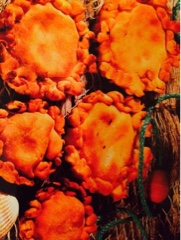
More gastronomically, perhaps, I turn to one of its local specialities - La Tielle de Sète. A kind of orange pastry, looking like a crab, and filled with octopus and tomato. My father reminded me of them the other day when he sent a postcard from nearby - we have been going to Sète since the 1980s - with a photograph of half a dozen and a recipe for the same. He had written "Yuk (I think)" on the back. My father does not like octopus.
I cannot find an English translation of "Tielle", only references to this dish - more commonly named La Tielle Sétoise - with the accent changed from a grave to an acute. There is probably a linguistic term for that but this is a piece about food. I also learn that Tielle is based on the Italian Tiella di Gaeta, Tiella meaning "pan" and the whole dish being prepared like a "pocket sandwich", whatever that might be. They look a little like pockets, I suppose, so that is what I shall call them. Sétoise, incidentally, I perceive as a sauce with tomatoes, chilli and onion: orange-looking, exactly like these "tielles" in fact.
Here is the wording on the original postcard, followed by my attempt at a translation.
La Tielle de Sète
(Pour 6 personnes)
Prendre 1 kg de poulpes, les nettoyer et les plonger dans un court bouillon. Faire blondir 200 g d'oignons dans un peu d'huile avec 2 gousses d'ail, 1 brin de persil et du concentré de tomates, ajouter du vin blanc, du sel, du poivre.
Faire cuire quelques minutes. Puis ajouter les poulpes apres les avoir coupés, du laurier, un peu de piment et laisser cuire 20 mn.
Pendant ce temps préparer une pâte à pain avec 1 kg de farine, de l'eau et de la levure. Mettre la pâte dans une moule, garni avec la farce et recouvrir du reste de pâte en formant un couvercle en le soudant avec de l'eau bien hermétiquement. Badigeonner d'huile et laisser cuire 15 mn à 20 mn thermostat 7°.
POCKETS FROM SÈTE
(Serves 6)
Take one kilo of octopus, clean and immerse in a "court bouillon". Sauté 200 g of onions in a little oil with two cloves of garlic, one sprig of parsley and some tomato purée; add white wine, salt and pepper.
Cook for a few minutes. Then add the octopus having cut it, with bay leaf and a sprinkle of pepper and cook for twenty minutes.
Meanwhile, prepare a bread dough with one kilo of flour, water and yeast. Put the dough in a pan, top with the octopus mixture and cover with the remaining dough, forming a cover by sealing with water.
Brush with oil and cook for fifteen to twenty minutes at gas mark 7.
Take one kilo of octopus, clean and immerse in a "court bouillon". Sauté 200 g of onions in a little oil with two cloves of garlic, one sprig of parsley and some tomato purée; add white wine, salt and pepper.
Cook for a few minutes. Then add the octopus having cut it, with bay leaf and a sprinkle of pepper and cook for twenty minutes.
Meanwhile, prepare a bread dough with one kilo of flour, water and yeast. Put the dough in a pan, top with the octopus mixture and cover with the remaining dough, forming a cover by sealing with water.
Brush with oil and cook for fifteen to twenty minutes at gas mark 7.
Tuesday, 18 November 2014
The Wonderful Soup Stone
"I swear you could taste
The Chicken and Tomato
And the Noodle and the Marrow bone.
But it really wasn't nothing
But some water and potatoes
And the wonderful, wonderful soup stone."
A song I recall from my childhood, by Dr Hook: simple, evocative and telling a story. The song goes on to reminisce about the singer's own childhood ("back in the hard time days") and his mama and, "whenever things got tight", production of the magical soup stone:
"Mama boiled up some water, put in the stone and said "Let's have some soup tonight!""
It is a somewhat less cynical version of the "Stone Soup" fairy tale which I also first read as a child. It concerns a wanderer who arrives at the hut of a man who, rather ungraciously, agrees to offer the traveller lodging for the night. The traveller has seen through a window that the hut owner has a larder full of food. But all he is offered is some dry bread. So he offers to make soup with his magic "soup stone". Delighted at the prospect of a free dinner, the man agrees and the traveller begins cooking. Presently, he suggests that some potatoes would be a good addition; and how about some chicken; and if the man happens to have any herbs, that really would make it not just a good soup but a superb soup. Eagerly, the man empties his cupboard and the soup is made. The following day, the traveller reluctantly agrees to sell his stone to the man in return for his gold hoard. There is another version of the story called "Nail broth".
The Chicken and Tomato
And the Noodle and the Marrow bone.
But it really wasn't nothing
But some water and potatoes
And the wonderful, wonderful soup stone."
A song I recall from my childhood, by Dr Hook: simple, evocative and telling a story. The song goes on to reminisce about the singer's own childhood ("back in the hard time days") and his mama and, "whenever things got tight", production of the magical soup stone:
"Mama boiled up some water, put in the stone and said "Let's have some soup tonight!""
It is a somewhat less cynical version of the "Stone Soup" fairy tale which I also first read as a child. It concerns a wanderer who arrives at the hut of a man who, rather ungraciously, agrees to offer the traveller lodging for the night. The traveller has seen through a window that the hut owner has a larder full of food. But all he is offered is some dry bread. So he offers to make soup with his magic "soup stone". Delighted at the prospect of a free dinner, the man agrees and the traveller begins cooking. Presently, he suggests that some potatoes would be a good addition; and how about some chicken; and if the man happens to have any herbs, that really would make it not just a good soup but a superb soup. Eagerly, the man empties his cupboard and the soup is made. The following day, the traveller reluctantly agrees to sell his stone to the man in return for his gold hoard. There is another version of the story called "Nail broth".
Tuesday, 6 November 2012
MOT
Stands for marmite, onion and tomato. That doesn't do it justice. Let me do some explaining.
First, good bread: one of those slightly dry "pain de campagne" or a baguette. Lightly toasted. Then spread marmite thinly on it; butter underneath the marmite if you wish. Finely chop some cherry tomatoes, or any other kind of tomato, provided it isn't Dutch. Then finely chop a shallot, or about a third of an onion. Mix with the tomato and squeeze on some lemon juice. Scatter it on the marmited toast. Scrape the tomato juices and any stray pips from the chopping board on to the bits of toast as well. Eat.

First, good bread: one of those slightly dry "pain de campagne" or a baguette. Lightly toasted. Then spread marmite thinly on it; butter underneath the marmite if you wish. Finely chop some cherry tomatoes, or any other kind of tomato, provided it isn't Dutch. Then finely chop a shallot, or about a third of an onion. Mix with the tomato and squeeze on some lemon juice. Scatter it on the marmited toast. Scrape the tomato juices and any stray pips from the chopping board on to the bits of toast as well. Eat.
Monday, 29 October 2012
Mortadella
I first visited Italy on 11 September 2001. Cousin Pen took
us there by motorway from Lorgues in Provence to just over the border: Ventimiglia.
The purpose of the trip was to go to the post office to pay a parking fine that
one of my other cousins had incurred. It was a good excuse.
As we drove through the tunnel at the border, I
concentrated, hard, on the fact that we were entering Italy. On the other side,
we descended into the town.
The so-called purpose of going, the post office, was quickly
over. Of much greater interest to us all was Pen's favourite food shop.
You know how many supermarkets in England have a cheerful
"Try before you buy" sign at the delicatessen counter. I always feel
slightly guilty for asking and, when I do, it becomes such a big deal to
produce a wafer thin fragment of ham or whatever, presented to me on a cocktail
stick, that I end up buying some. Possibly the point.
The lady behind the counter in Pen's shop had a different
approach. I would express the vaguest interest in a particular salami or some
Parma ham and she would immediately seize the article, rush to the slicing
machine and produce enough for all three of us to have a large mouthful. Of
course, we would end up buying some. A lot. Possibly the point. But the feeling
in that shop was one of generosity. (Later, Pen would reveal that the woman
running the shop may in fact have, dishonestly or otherwise, charged us
incorrectly and in the shop’s favour – but let me give the shopkeeper the
benefit of the doubt. I warmed to her.)
The title of this piece is Mortadella and that is one thing
I did not buy at that shop in Ventimiglia. But I saw it for the first time I can
remember. Not surprisingly. It was the largest sausage I have ever seen.
Slightly off-putting.
Since then, though, I have grown to love it. As cousin Pen
told me later, it is great picnic food. Folded into good bread, with slices of
tomato, lettuce and a little mayonnaise , its moist slightly bland saltiness is
welcome at the edge of the road on the way, say, from Rome to Lorgues.
But be warned: there is plenty of rogue Mortadella out
there. I would say as general rules:
Only buy it loose, never in packets.
 Part 2 of the trip to Ventimiglia to follow.

Sunday, 28 October 2012
Tomato salad
The photograph is authentic but doesn't reflect the point of the dish. A mustardy vinaigrette is all very well but good tomatoes demand nothing more than good olive oil, salt and a few shavings of shallot. The mustard and vinegar only becomes essential if the tomatoes are disappointing: I recommend Dutch if you truly want to experience the fourth state of water.
It is those misshapen tomatoes, almost pumpkin-like, with a taste that burns the back of the throat that are required here. I found some once, in Montagnac market. The friend who had taken me insisted on whisking me past all the stalls until we reached the man at the end who had what appeared to be the contents of his (small) garden on the plastic table. About eight years ago and never forgotten. Lunch of those tomatoes, olive oil and bread to mop the juices.

It is those misshapen tomatoes, almost pumpkin-like, with a taste that burns the back of the throat that are required here. I found some once, in Montagnac market. The friend who had taken me insisted on whisking me past all the stalls until we reached the man at the end who had what appeared to be the contents of his (small) garden on the plastic table. About eight years ago and never forgotten. Lunch of those tomatoes, olive oil and bread to mop the juices.
Sunday, 21 October 2012
Aloo Chat
From my mother's recipe book, in her italic hand
* 5 large potatoes cut in quarters - boil in salted water until still too firm for potato salad. Drain. Cool and then peel. Cut into bite sized pie
* 2 green peppers cut into 1 cm cubes.
* 2 large onions cut into 1 cm cubes.
* 4 tablespoons olive oil.
* 1 tin chopped tomatoes.
* 2 dessert spoons curry powder.
* 2 dessert spoons garam masala.
* Salt.
* Pepper.
Fry peppers and onion in two spoons olive oil gently for 10 minutes, stirring occasionally.
Add curry powder and garam masala.
Stir until veg are evenly coated.
Fry gently for a couple of minutes.
Add rest of olive oil, potatoes and tin of tomatoes.
Simmer gently, uncovered, until liquid is absorbed.
Season to taste. Serve hot, warm or cold. (Don't stir too vigorously - keep the potato pieces intact.)
Now for the commentary. This is not a recipe I remember from childhood, but something from much later - perhaps even my early twenties. I think that Mum discovered it in our local Indian restaurant, the Viceroy, and attempted to recreate it at home. It is superb picnic food and it became traditional to take it in the car for the drive across France: each of us would have one of those sandwich bags full of the stuff and a fork. It was christened something other than aloo chat but I will not repeat it here because it might discourage the reader from attempting it.
Something to eat which, as the recipe says, is good whether hot, warm or cold. Although, as my mother would say, "it's even better cold ". Is there a name for such dishes?
I am, incidentally, assured by my friend, Nina Ali, that this is an utterly inauthentic recipe.

* 5 large potatoes cut in quarters - boil in salted water until still too firm for potato salad. Drain. Cool and then peel. Cut into bite sized pie
* 2 green peppers cut into 1 cm cubes.
* 2 large onions cut into 1 cm cubes.
* 4 tablespoons olive oil.
* 1 tin chopped tomatoes.
* 2 dessert spoons curry powder.
* 2 dessert spoons garam masala.
* Salt.
* Pepper.
Fry peppers and onion in two spoons olive oil gently for 10 minutes, stirring occasionally.
Add curry powder and garam masala.
Stir until veg are evenly coated.
Fry gently for a couple of minutes.
Add rest of olive oil, potatoes and tin of tomatoes.
Simmer gently, uncovered, until liquid is absorbed.
Season to taste. Serve hot, warm or cold. (Don't stir too vigorously - keep the potato pieces intact.)
Now for the commentary. This is not a recipe I remember from childhood, but something from much later - perhaps even my early twenties. I think that Mum discovered it in our local Indian restaurant, the Viceroy, and attempted to recreate it at home. It is superb picnic food and it became traditional to take it in the car for the drive across France: each of us would have one of those sandwich bags full of the stuff and a fork. It was christened something other than aloo chat but I will not repeat it here because it might discourage the reader from attempting it.
Something to eat which, as the recipe says, is good whether hot, warm or cold. Although, as my mother would say, "it's even better cold ". Is there a name for such dishes?
I am, incidentally, assured by my friend, Nina Ali, that this is an utterly inauthentic recipe.

Subscribe to:
Posts (Atom)