This looks like one of my mother's more recent recipes. Serves 4:
1 knob butter
1 finely chopped onion
500 g flat mushrooms (finely sliced)
50 g dried porcini (soaked)
4 bashed cloves garlic
1 glass white wine
1 l fresh chicken stock or tinned consommé diluted 50/50 with water
100 ml crème fraiche
Soak porcini in hot water until soft. Melt butter in large saucepan & add next 4 ingredients. Turn down heat & cover. Cook gently for 20 m. Add white wine & reduce by 1/2. Add stock & bring to boil. Simmer 10 m & add cream. Remove heat. Liquidise in small batches and return to clean pan. Season with salt and pepper.
Showing posts with label garlic. Show all posts
Showing posts with label garlic. Show all posts
Friday, 22 January 2016

Friday, 15 January 2016
Marinated lamb with potato salad
My personal recipe book contains a number of newspaper clippings: recipes that I like the sound of but have rarely (if ever) got round to testing. Here is one such cutting, attributed to Ruth Quinlan.
Serves 6.
Ingredients:
2 whole fillets or 6 steaks lamb
4 cloves garlic
4 twigs rosemary
1 tbsp. ground black pepper
1 kg new potatoes
200 g green beans
1 tbsp capers
2 tsp paprika
1 lemon (juice and zest)
150 ml olive oil
Method:
Chop the garlic and rosemary leaves and mix with the pepper and enough oil to coat the meat. Leave in a cool place for at least six hours or overnight. Boil the potatoes and the beans. While still hot, break the potatoes in half using your finger and toss with the rest of the ingredients. When the barbecue is red-hot, sprinkle salt on the meat and cook the steaks for eight minutes and the fillet for 15 - 20 minutes. Rest the meat in a warm place for ten minutes. Serve with the warm potato salad. If you are using fillet, slice thickly. In case of rain, grill (full power) or roast (220 degrees C/mark 7) the meat. The same cooking times apply.
Serves 6.
Ingredients:
2 whole fillets or 6 steaks lamb
4 cloves garlic
4 twigs rosemary
1 tbsp. ground black pepper
1 kg new potatoes
200 g green beans
1 tbsp capers
2 tsp paprika
1 lemon (juice and zest)
150 ml olive oil
Method:
Chop the garlic and rosemary leaves and mix with the pepper and enough oil to coat the meat. Leave in a cool place for at least six hours or overnight. Boil the potatoes and the beans. While still hot, break the potatoes in half using your finger and toss with the rest of the ingredients. When the barbecue is red-hot, sprinkle salt on the meat and cook the steaks for eight minutes and the fillet for 15 - 20 minutes. Rest the meat in a warm place for ten minutes. Serve with the warm potato salad. If you are using fillet, slice thickly. In case of rain, grill (full power) or roast (220 degrees C/mark 7) the meat. The same cooking times apply.
Saturday, 9 January 2016
Savoury mousse
Another source of material has emerged in the shape of my grandmother's battered red file of recipes, some typed, some handwritten. I dislike the title of the first recipe, "Cheese special" - but having sampled a few scrapings from the bowl in advance of a dinner party where this was the starter, can testify to its goodness.
Ingredients:
1 Philadelphia cheese
1 Boursin cheese with garlic
1 tin of C&B consommé - 8 oz
1 teaspoon Worcester sauce
4 oz single cream
Optional: a few prawns or shrimps
A little parsley
Method:
Put 3/4 of consommé into bleder.
Add both cheeses, Worcester sauce and cream.
Mix slowly if slightly lumpy or fast if smooth result required.
Pour into 5 or 6 ramekin dishes leaving 1/4 inch space at top.
Optional: add prawns/shrimps by hand before pouring into dishes.
Place in fridge for about 1/2 hour.
Remove from fridge and pour remaining consommé on top.
Return to fridge.
Serve:
Remove from fridge a few minutes before serving and sprinkle with a little parsley.
A very seventies dish which sounds potentially disgusting but is in fact rather good. Although I can certainly recall Granny making this as described above, I think my mother did something similar but without the consommé on top which she called "Snaffles mousse".
Ingredients:
1 Philadelphia cheese
1 Boursin cheese with garlic
1 tin of C&B consommé - 8 oz
1 teaspoon Worcester sauce
4 oz single cream
Optional: a few prawns or shrimps
A little parsley
Method:
Put 3/4 of consommé into bleder.
Add both cheeses, Worcester sauce and cream.
Mix slowly if slightly lumpy or fast if smooth result required.
Pour into 5 or 6 ramekin dishes leaving 1/4 inch space at top.
Optional: add prawns/shrimps by hand before pouring into dishes.
Place in fridge for about 1/2 hour.
Remove from fridge and pour remaining consommé on top.
Return to fridge.
Serve:
Remove from fridge a few minutes before serving and sprinkle with a little parsley.
A very seventies dish which sounds potentially disgusting but is in fact rather good. Although I can certainly recall Granny making this as described above, I think my mother did something similar but without the consommé on top which she called "Snaffles mousse".
Wednesday, 30 December 2015
Salad dressing
Sequels written by somebody other than the original author lend themselves to the prospect of savage criticism by disappointed readers. The Bond books are a case in point. I have rather enjoyed the tradition of writers renowned for their own creations - Kingsley Amis, for example - continuing where Ian Fleming left off. It is particularly pleasing when such writers clearly know their original material so well that they do not merely repeat it but take it further.
In Fleming's "Moonraker", we learn that James Bond takes his own "mustardy" salad dressing to the secret service canteen for lunch. More exotically, in William Boyd's "Solo", Bond even insists on his own version in "the best steak restaurant in Washington" where he is brought a small lacquered tray with "all the ingredients necessary to make a vinaigrette to his own secret formula": these last two words a stock phrase beautifully pinched, no doubt with relish, from the archetypal spy novel. The ingredients are set out in the novel as follows:
a little carafe of olive oil;
a little carafe of red-wine vingegar;
a jar of Dijon mustard;
a halved-clove of garlic;
a black-pepper grinder;
a ramekin of granulated sugar;
a bowl;
A teaspoon; and
a small balloon whisk to mix the ingredients together.
The method for the authentic-sounding recipe is revealed in the only footnote in the entire novel:
a little carafe of olive oil;
a little carafe of red-wine vingegar;
a jar of Dijon mustard;
a halved-clove of garlic;
a black-pepper grinder;
a ramekin of granulated sugar;
a bowl;
A teaspoon; and
a small balloon whisk to mix the ingredients together.
The method for the authentic-sounding recipe is revealed in the only footnote in the entire novel:
"Mix five parts of red-wine vinegar with one part extra-virgin olive oil. The vinegar overload is essential. Add a halved clove of garlic, half a teaspoon of Dijon mustard, a good grind of black pepper and a teaspoon of white granulated sugar. Mix well, remove the garlic and dress the salad.”
We are told that Bond ended his meal with "half an avocado into which he poured what remained of his dressing". I must at some point try a similar demand in a restaurant.
We are told that Bond ended his meal with "half an avocado into which he poured what remained of his dressing". I must at some point try a similar demand in a restaurant.
Friday, 7 August 2015
Tom's salad dressing
Sent to me in a text and worth publishing without amendment:
"Just discovered the most delicious salad dressing: liquidise olive oil, red wine vinegar, Dijon mustard and raw garlic. Utterly amazing."
Monday, 3 August 2015
La Tielle de Sète
I have written or thought about writing about Sète before: it is where I had one of the best burgers in my life, at the railway station.
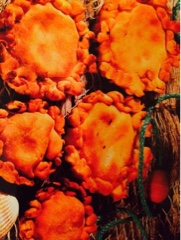
More gastronomically, perhaps, I turn to one of its local specialities - La Tielle de Sète. A kind of orange pastry, looking like a crab, and filled with octopus and tomato. My father reminded me of them the other day when he sent a postcard from nearby - we have been going to Sète since the 1980s - with a photograph of half a dozen and a recipe for the same. He had written "Yuk (I think)" on the back. My father does not like octopus.
I cannot find an English translation of "Tielle", only references to this dish - more commonly named La Tielle Sétoise - with the accent changed from a grave to an acute. There is probably a linguistic term for that but this is a piece about food. I also learn that Tielle is based on the Italian Tiella di Gaeta, Tiella meaning "pan" and the whole dish being prepared like a "pocket sandwich", whatever that might be. They look a little like pockets, I suppose, so that is what I shall call them. Sétoise, incidentally, I perceive as a sauce with tomatoes, chilli and onion: orange-looking, exactly like these "tielles" in fact.
Here is the wording on the original postcard, followed by my attempt at a translation.
La Tielle de Sète
(Pour 6 personnes)
Prendre 1 kg de poulpes, les nettoyer et les plonger dans un court bouillon. Faire blondir 200 g d'oignons dans un peu d'huile avec 2 gousses d'ail, 1 brin de persil et du concentré de tomates, ajouter du vin blanc, du sel, du poivre.
Faire cuire quelques minutes. Puis ajouter les poulpes apres les avoir coupés, du laurier, un peu de piment et laisser cuire 20 mn.
Pendant ce temps préparer une pâte à pain avec 1 kg de farine, de l'eau et de la levure. Mettre la pâte dans une moule, garni avec la farce et recouvrir du reste de pâte en formant un couvercle en le soudant avec de l'eau bien hermétiquement. Badigeonner d'huile et laisser cuire 15 mn à 20 mn thermostat 7°.
POCKETS FROM SÈTE
(Serves 6)
Take one kilo of octopus, clean and immerse in a "court bouillon". Sauté 200 g of onions in a little oil with two cloves of garlic, one sprig of parsley and some tomato purée; add white wine, salt and pepper.
Cook for a few minutes. Then add the octopus having cut it, with bay leaf and a sprinkle of pepper and cook for twenty minutes.
Meanwhile, prepare a bread dough with one kilo of flour, water and yeast. Put the dough in a pan, top with the octopus mixture and cover with the remaining dough, forming a cover by sealing with water.
Brush with oil and cook for fifteen to twenty minutes at gas mark 7.
Take one kilo of octopus, clean and immerse in a "court bouillon". Sauté 200 g of onions in a little oil with two cloves of garlic, one sprig of parsley and some tomato purée; add white wine, salt and pepper.
Cook for a few minutes. Then add the octopus having cut it, with bay leaf and a sprinkle of pepper and cook for twenty minutes.
Meanwhile, prepare a bread dough with one kilo of flour, water and yeast. Put the dough in a pan, top with the octopus mixture and cover with the remaining dough, forming a cover by sealing with water.
Brush with oil and cook for fifteen to twenty minutes at gas mark 7.
Friday, 12 April 2013
Margaret Thatcher and the Sausages
In the aftermath of her death, I feel the need to record something in connection with Margaret Thatcher and food. My immediate thought as I started to write, though, was that, unlike many other things, food is a topic on which she never, publicly, pronounced.
Having said that, I realise I am wrong. I recall that in her memoirs, she referred to having a Chinese takeaway on her first night in Downing Street and having to cater, on subsequent occasions, for the many visitors to Number 10. She asserts that there was always "something to cut at" in the fridge, says she knew every way with eggs, and, in particular, mentions with approval Bovril toast with a poached egg on top. One MP recently recalled the ubiquity of Coronation Chicken at Number 10. The absence of staff in the Downing Street flat to do your every bidding is one of the more attractive aspects of the British Constitution. Keeps our Prime Ministers down to earth.
But there were, on occasions, compensations. And Chequers had staff. I seem to remember that Gorbachev sent the Prime Minister a pot of caviar at Christmas, which she contributed to the cold collation at Chequers on Christmas night. (Personally I'd have been tempted to tuck it away, wait until the guests had left and then demolish it with a horn spoon.) One of her guests told the story of how, in the absence of the staff, who were given Christmas night off, the Prime Minister insisted on personally returning the half-eaten pot to the fridge in the deserted kitchen at Chequers.
She did not like garlic, I have read somewhere, and Denis, I am told, used to insist upon his steak being cooked to within an inch of its life... Definitely middle England. On the strength of those prejudices alone, I might have struggled to get through dinner in the Thatcher household, in the highly unlikely event of my being invited.
There is another story (which her biographer Charles Moore insists, probably accurately, never happened) of her going to some European summit and the then German Chancellor turning down her invitation to coffee. Followed by the embarrassment, a little later, of spotting him in a cafe stuffing his face with Black Forest Gateau... Despite all these reminiscences, I am not aware of her ever having expressed any views on iron-rich food.
Since publishing an earlier version of this piece, I have discovered, to my delight, a recorded reference to Margaret Thatcher and sausage dating back over fifty years - to 1962, when she was a mere MP, and provided some Christmas recipes for her local paper. The Margaret Thatcher Foundation website, no doubt with an eye to the bigger historical picture, classifies the document as "trivial". I disagree. It is wonderful on many levels and worth reading in full. Here is a taster: what the diarist, Margaret Clifton, says about Margaret Thatcher and sausage. "With an eye on something to serve with the cold bird, which, says Mrs. Thatcher 'seems to go on for ever!' she makes Sausage Stuffing as an extra. She forms it into sausage shapes, which she coats with egg and breadcrumbs. This way, she has plenty of spare stuffings for after-Christmas-Day meals. Like most mothers, she feels that the Sauces grown-ups like for the Christmas Pudding are too rich for the children; she serves single cream with the pudding, for her twins, Carol and Mark".
My earliest encounter with Margaret Thatcher was in December 1978. She was then Leader of the Opposition. Five months later she would be Prime Minister. The occasion was the House of Commons Children's Christmas party. The children of MPs and others had been invited. My brother and I secured an invitation because our father was a political journalist.
I have this vague memory of seeing Margaret Thatcher slipping past the long tables of children stuffing their faces with party food. Even then, she stood out from the crowd. The only other person I recall meeting that evening was Father Christmas. I am now wondering to myself whether he might have been Jim Callaghan or Denis Healey in disguise...
The food on offer included sausages and baked beans, which I rejected, to the consternation of my mother who probably feared I would complain of hunger later. Curiously, it was the subject of sausages and beans on which Margaret Thatcher chose to engage my mother in conversation. Referring to another group of children who, like me, were none too keen on the sausages and baked beans, she gushed: "Of course, we won't expect the African children to eat their sausages and beans, will we?" Telling the story later, my mother says that she gave Mrs Thatcher a look but did not reply...
About twenty-five years later, long after Margaret Thatcher had ceased to be Prime Minister, I was at a function in Middle Temple which she attended. I am no expert in meeting the famous but happened, shortly after the speeches, to be standing right next to her. The proof is below. No one else was there so I turned to her and blurted out some gauche remark about how grateful I was that she hadn't made me eat my sausages and baked beans at that party. "You should never force children to eat what they don't want to eat", she asserted, and with that, our audience was at an end...

Having said that, I realise I am wrong. I recall that in her memoirs, she referred to having a Chinese takeaway on her first night in Downing Street and having to cater, on subsequent occasions, for the many visitors to Number 10. She asserts that there was always "something to cut at" in the fridge, says she knew every way with eggs, and, in particular, mentions with approval Bovril toast with a poached egg on top. One MP recently recalled the ubiquity of Coronation Chicken at Number 10. The absence of staff in the Downing Street flat to do your every bidding is one of the more attractive aspects of the British Constitution. Keeps our Prime Ministers down to earth.
But there were, on occasions, compensations. And Chequers had staff. I seem to remember that Gorbachev sent the Prime Minister a pot of caviar at Christmas, which she contributed to the cold collation at Chequers on Christmas night. (Personally I'd have been tempted to tuck it away, wait until the guests had left and then demolish it with a horn spoon.) One of her guests told the story of how, in the absence of the staff, who were given Christmas night off, the Prime Minister insisted on personally returning the half-eaten pot to the fridge in the deserted kitchen at Chequers.
She did not like garlic, I have read somewhere, and Denis, I am told, used to insist upon his steak being cooked to within an inch of its life... Definitely middle England. On the strength of those prejudices alone, I might have struggled to get through dinner in the Thatcher household, in the highly unlikely event of my being invited.
There is another story (which her biographer Charles Moore insists, probably accurately, never happened) of her going to some European summit and the then German Chancellor turning down her invitation to coffee. Followed by the embarrassment, a little later, of spotting him in a cafe stuffing his face with Black Forest Gateau... Despite all these reminiscences, I am not aware of her ever having expressed any views on iron-rich food.
Since publishing an earlier version of this piece, I have discovered, to my delight, a recorded reference to Margaret Thatcher and sausage dating back over fifty years - to 1962, when she was a mere MP, and provided some Christmas recipes for her local paper. The Margaret Thatcher Foundation website, no doubt with an eye to the bigger historical picture, classifies the document as "trivial". I disagree. It is wonderful on many levels and worth reading in full. Here is a taster: what the diarist, Margaret Clifton, says about Margaret Thatcher and sausage. "With an eye on something to serve with the cold bird, which, says Mrs. Thatcher 'seems to go on for ever!' she makes Sausage Stuffing as an extra. She forms it into sausage shapes, which she coats with egg and breadcrumbs. This way, she has plenty of spare stuffings for after-Christmas-Day meals. Like most mothers, she feels that the Sauces grown-ups like for the Christmas Pudding are too rich for the children; she serves single cream with the pudding, for her twins, Carol and Mark".
My earliest encounter with Margaret Thatcher was in December 1978. She was then Leader of the Opposition. Five months later she would be Prime Minister. The occasion was the House of Commons Children's Christmas party. The children of MPs and others had been invited. My brother and I secured an invitation because our father was a political journalist.
I have this vague memory of seeing Margaret Thatcher slipping past the long tables of children stuffing their faces with party food. Even then, she stood out from the crowd. The only other person I recall meeting that evening was Father Christmas. I am now wondering to myself whether he might have been Jim Callaghan or Denis Healey in disguise...
The food on offer included sausages and baked beans, which I rejected, to the consternation of my mother who probably feared I would complain of hunger later. Curiously, it was the subject of sausages and beans on which Margaret Thatcher chose to engage my mother in conversation. Referring to another group of children who, like me, were none too keen on the sausages and baked beans, she gushed: "Of course, we won't expect the African children to eat their sausages and beans, will we?" Telling the story later, my mother says that she gave Mrs Thatcher a look but did not reply...
About twenty-five years later, long after Margaret Thatcher had ceased to be Prime Minister, I was at a function in Middle Temple which she attended. I am no expert in meeting the famous but happened, shortly after the speeches, to be standing right next to her. The proof is below. No one else was there so I turned to her and blurted out some gauche remark about how grateful I was that she hadn't made me eat my sausages and baked beans at that party. "You should never force children to eat what they don't want to eat", she asserted, and with that, our audience was at an end...
Wednesday, 3 April 2013
Lemon
So much of a lemon often gets discarded: the pips, rightly; the skins, which is often a waste (see Lemon pickle (2)); but most often the part that does not have a name. I will call it the residue. Imagine chopping the lemon or juicing it. On the chopping board or still in the juiced lemon is a mixture of flesh and juice, of solid and liquid. The point is that there is nothing inedible about it. Both the flavour and texture are good. Just for stirring into a mayonnaise or a curry, say.
Are there any other fruits or even vegetables that have so many different parts from the cook's perspective: zest, peel, juice and flesh. Compare other staples: onions, garlic, carrots, celery. All essential ingredients but in each case only one part that can be eaten: I might be prepared to accept that celery has a couple of other parts beside the flesh with culinary value: the leaves and the seeds.
The lemon is one of my eight desert island foods. Its ability to cut through richness, to alter flavour, to destroy blandness makes it a crucial thing to have around. Then there's always lemon pickle...
Are there any other fruits or even vegetables that have so many different parts from the cook's perspective: zest, peel, juice and flesh. Compare other staples: onions, garlic, carrots, celery. All essential ingredients but in each case only one part that can be eaten: I might be prepared to accept that celery has a couple of other parts beside the flesh with culinary value: the leaves and the seeds.
The lemon is one of my eight desert island foods. Its ability to cut through richness, to alter flavour, to destroy blandness makes it a crucial thing to have around. Then there's always lemon pickle...
Saturday, 17 November 2012
Bolognese sauce
It seems to me that there are only four essential ingredients of a Bolognese sauce although the Bolognese themselves might well disagree - just as they would never serve this sauce with spaghetti. For reasons I have articulated elsewhere (round food) I don't rave about spaghetti much anyway. My pasta of choice with this sauce is tagliatelle. James Bond and I would disagree about the choice of pasta if not the sauce. In Thunderball, one of the "three obsessions which belonged to his former life and which would not leave him" was: "a passionate longing for a large dish of Spaghetti Bolognese containing plenty of chopped garlic and accompanied by a whole bottle of the cheapest, rawest Chianti (bulk for his empty stomach and sharp tastes for his starved palate)". This is possibly the first dish I was ever taught to cook and it got me through university. When I first published this version, I received a particularly helpful critique and have incorporated some of the suggestions from it into this revised version.
Those essential ingredients, then: an onion, about 1 lb or 500 g of minced beef, a small tin of tomato purée (I would not have added an accent but the device I am using cleverly did so) and the empty tin filled with water and stirred so as to leave the tin shiny and no remnants of tomato within it. There will be ample fat in the mince for cooking purposes. Just these ingredients will make a rich sauce far better and more cheaply than anything from a jar. One of those dishes like Shepherd's Pie which is simply not worth eating other than at home.
That said, I have refined the sauce over the years and would add the following optional ingredients: a clove of garlic, a pinch of thyme or oregano, a bay leaf, a little freshly ground black pepper, a finely-chopped carrot or two, a stick of celery, a tin of chopped Italian tomatoes, a splash of olive oil and a splash of red wine. The imprecision of some of the quantities given is not intended to sound airy or unhelpful but to demonstrate that, unlike some other recipes, it's fairly flexible. NOT, though, when it comes to certain additional ingredients...
Let me do some explaining. This, above all, is a meat sauce. The onion, garlic, celery and carrot are condiments only, to melt unobtrusively. You do not want great lumps of them in this sauce. Nor, in my view, should other, alien ingredients, such as mushrooms, peppers or, dare I say it, sweetcorn, be added. Nor am I convinced by the addition of a handful of lardons or pancetta, which is contrary to what I said in yet another earlier version of this post. The recipe continues to evolve! I like to think I favour liberalism in cooking. And if you fancy a mince and vegetable sauce for your pasta, fine. But it seems to me that too many extra vegetables or whatever cross the line between what can legitimately call itself Bolognese and what cannot. The other thing to add, while I'm being principled, is that this is a thick meat sauce: it shouldn't be watery.
The method, leaving out steps depending on the optional ingredients...
1. Finely chop an onion. My only tip on avoiding tears is this. Peel it all first and don't chop off the ends until you've done so. You want to minimise the amount of time following the first cut which starts to release in vapourised form the (very dilute) sulphuric acid that attacks the eyes.
2. Heat about a teaspoon of olive oil in a frying pan. If you're not using any oil, leave out step 5: ie add the mince first, followed by the onion.
3. Finely chop the garlic if you're using it. Warm it gently in the oil. Remove once it's added flavour to the oil.
4. If you're using lardons, fry them at this stage.
5. Fry the finely chopped onion, stirring frequently to prevent it from burning.
6. Put the mince into the frying pan, turn the heat up and brown the mince on all sides. Gradually mix the mince with the onion. Stir frequently, breaking up any clumps of mince as you do so and stopping the onion from burning. Shake the pan every so often. If there's a lot of fat in the pan, now's a good opportunity to pour it off.
7. If you're adding any of the other optional vegetables (carrot and celery), add them at this stage, as finely chopped as you can. To repeat myself, they are condiments. Similarly, the thyme, bay leaf and FGBP can all go in at this stage.
8. Add the tomato purée. Because of its thick consistency, it may be a struggle at first to mix it with the mince. Persevere: the heat will rapidly cause it to melt. Don't add water at this stage, but stir furiously. You don't want the tomato - or anything - to burn but the direct heat at this stage seals in the flavour. I think.
9. The trick, I have decided, is to cook everything on the highest possible heat you dare (stirring furiously as burnt onions are horrid) until you add the water, whereupon you turn the heat as low as it will go.
10. Add the splash of wine and/or chopped tomatoes if they're going in.
11. Finally, add the water. Turn the heat down to its lowest possible setting. Let the sauce bubble gently. Scrape down the sides of the pan every so often. Stir and/or add a little more water every so often if there's a danger of sticking.
12. I think this should be allowed to simmer for 45 minutes or longer. There should be some, but not too much, rich red liquid on the top. Cook the pasta. Eat.
Some reminiscences. This was the first thing I was taught to cook before I went off to university. It's still a staple. On one occasion - this was before I had learned to cook it - we had all been to the theatre with an extended party of family and friends. The plan was that Mum was going to cook this when we got home afterwards. But she had to be dropped off at the local hospital, having got something in her eye. So my father took us all home and asked us what we'd like to eat. In an injudicious attempt to lighten the atmosphere, I said airily, "Oh you know, some smoked salmon, some caviar, something like that". In my defence, I hadn't appreciated my mother was actually in casualty; she happened to work in the hospital and I'd thought one of her colleagues was going to sort her out. In any event, my father didn't lose his temper in front of guests but we were swiftly banished from the kitchen and he put together a bolognese sauce about which one of my cousins was a little doubtful. My roasting came the following day after everyone had left...

Tuesday, 6 November 2012
Herrings Alethea
Alethea was my mother's first name. This is the first recipe in the "fish" section of her recipe book and it is written in red biro in handwriting I don't recognise but may be an earlier incarnation of hers.
At the foot of the recipe in brackets is my mother's maiden name, A. Weiss, followed by a word that I cannot read. Next to the name "Herrings Alethea" in different-coloured ink is an address: 111 Woodstock Road Oxford. Was this something she cooked when working as a secretary in Oxford before she went to university? Strangely, someone has crossed out the recipe. But it is still legible and, for the record, here it is below. I don't remember ever having eaten it.
Cut and fillet 1 herring for each person. Lay flat on floured board and place slices of garlic, dabs of French mustard and a few drops of lemon juice. Clean 1 small sweet pepper and a couple of tomatoes, fry them lightly in cooking oil along with a few very thin slices of onion.
Place a few teaspoons of this mixture inside each herring, roll it up and place in a greased baking tin. Plcae remains of tomato/pepper mixture on and around fish and then pour about half a cup of milk over them. (The roes should be chopped up and placed inside the fish.) Season and bake [?] in a low oven until fish is tender.
At the foot of the recipe in brackets is my mother's maiden name, A. Weiss, followed by a word that I cannot read. Next to the name "Herrings Alethea" in different-coloured ink is an address: 111 Woodstock Road Oxford. Was this something she cooked when working as a secretary in Oxford before she went to university? Strangely, someone has crossed out the recipe. But it is still legible and, for the record, here it is below. I don't remember ever having eaten it.
Cut and fillet 1 herring for each person. Lay flat on floured board and place slices of garlic, dabs of French mustard and a few drops of lemon juice. Clean 1 small sweet pepper and a couple of tomatoes, fry them lightly in cooking oil along with a few very thin slices of onion.
Place a few teaspoons of this mixture inside each herring, roll it up and place in a greased baking tin. Plcae remains of tomato/pepper mixture on and around fish and then pour about half a cup of milk over them. (The roes should be chopped up and placed inside the fish.) Season and bake [?] in a low oven until fish is tender.
Subscribe to:
Posts (Atom)