Showing posts with label crab. Show all posts

Monday, 3 August 2015

La Tielle de Sète

have written or thought about writing about Sète before: it is where I had one of the best burgers in my life, at the railway station.

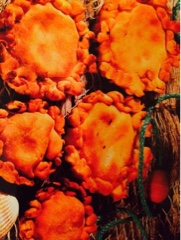
More gastronomically, perhaps, I turn to one of its local specialities - La Tielle de Sète. A kind of orange pastry, looking like a crab, and filled with octopus and tomato. My father reminded me of them the other day when he sent a postcard from nearby - we have been going to Sète since the 1980s - with a photograph of half a dozen and a recipe for the same. He had written "Yuk (I think)" on the back. My father does not like octopus.

I cannot find an English translation of "Tielle", only references to this dish - more commonly named La Tielle Sétoise - with the accent changed from a grave to an acute. There is probably a linguistic term for that but this is a piece about food. I also learn that Tielle is based on the Italian Tiella di Gaeta, Tiella meaning "pan" and the whole dish being prepared like a "pocket sandwich", whatever that might be. They look a little like pockets, I suppose, so that is what I shall call them. Sétoise, incidentally, I perceive as a sauce with tomatoes, chilli and onion: orange-looking, exactly like these "tielles" in fact.

Here is the wording on the original postcard, followed by my attempt at a translation.

La Tielle de Sète

(Pour 6 personnes)

Prendre 1 kg de poulpes, les nettoyer et les plonger dans un court bouillon. Faire blondir 200 g d'oignons dans un peu d'huile avec 2 gousses d'ail, 1 brin de persil et du concentré de tomates, ajouter du vin blanc, du sel, du poivre.


Faire cuire quelques minutes. Puis ajouter les poulpes apres les avoir coupés, du laurier, un peu de piment et laisser cuire 20 mn.

Pendant ce temps préparer une pâte à pain avec 1 kg de farine, de l'eau et de la levure. Mettre la pâte dans une moule, garni avec la farce et recouvrir du reste de pâte en formant un couvercle en le soudant avec de l'eau bien hermétiquement. Badigeonner d'huile et laisser cuire 15 mn à 20 mn thermostat 7°.

POCKETS FROM SÈTE

(Serves 6)

Take one kilo of octopus, clean and immerse in a "court bouillon". Sauté 200 g of onions in a little oil with two cloves of garlic, one sprig of parsley and some tomato purée; add white wine, salt and pepper.

Cook for a few minutes. Then add the octopus having cut it, with bay leaf and a sprinkle of pepper and cook for twenty minutes.

Meanwhile, prepare a bread dough with one kilo of flour, water and yeast. Put the dough in a pan, top with the octopus mixture and cover with the remaining dough, forming a cover by sealing with water.

Brush with oil and cook for fifteen to twenty minutes at gas mark 7.


Saturday, 24 November 2012

The Crab House

Some meals are memorable. This one was in the US, following the only time I have ever been in a train crash. It happened on our way from Charleston, South Carolina to Florida. Just outside Jacksonville, we came to a standstill with a jolt, having hit a car which, inexplicably, was on the track. Unlike the ending of “Back to the Future 3” in which the time-travelling DeLorean is hit by a train and destroyed, no damage seemed to have been done. No one, the driver assured us over the PA, was seriously hurt. We copied everybody when our train arrived in Orlando three hours late and walked over the rails towards the taxi rank.

As it was Florida, we should probably have looked for a restaurant serving Alligator. Instead, we headed for somewhere doing seafood. It was called "The Crab House”, on International Drive, halfway to Disneyworld and in the midst of Universal Studios. Other attractions included a “Just can’t believe it museum” where even the building itself was skew-wiff – a bit like the old King's School shop in Canterbury, only more so.

While waiting for a table in the restaurant, I went over to inspect the “unlimited salad bar”: masses of shrimp, oysters, mussels, clams and crabs. Seated and with our menus, I plumped for “half a lobster with snow crabs” while Mum chose “snow crabs and garlic crabs”. Our waiter did not approve and told us they were “not very good”. So I chose the unlimited salad bar instead, which the waiter seemed to think was a brilliant idea. Mum’s second choice, broiled shrimp, he didn't like either, and told her she could have “unlimited shrimp” on the salad bar. So Mum took the hint and chose that too and the waiter put on a broad grin and said in a drawn-out way, “Alright!” We speculated after he had disappeared that the menus were phoney and that the only thing available was the salad bar. The waiter soon brought us plates which we went and filled. More than once. As I stuffed myself with shrimp, Mum commented that she could eat the oysters almost as quickly as the man at the salad bar was opening them. Shortly after this, the waiter came over bearing a slightly anxious look on his face and a loaf of warm bread, which he urged us to try: “It’s really good”. But we were not as interested in filling ourselves up on the bread as he was keen to persuade us, and, instead, we took a further trip to the salad bar where we loaded our plates with seafood for a third time. Finally, we were defeated.

It all reminded me of the bit in Ian Fleming’s “Goldfinger”where James Bond, forced to spend the night in Florida, is treated to a meal at "Bills on the Beach” in Miami. Junius Du Pont, a man whom he met in the first Bond book, “Casino Royale”, is his host and does the ordering:

“Stone crabs. Not frozen. Fresh. Melted butter. Thick toast. Right?”

When the food arrives:

“With ceremony, a wide silver dish of crabs, big ones, their shells and claws broken, was placed in the middle of the table. A silver sauceboat brimming with melted butter and a long rack of toast was put beside each of their plates. The tankards of Champagne frothed pink. Finally, with an oily smirk, the head waiter came behind their chairs and, in turn, tied round their necks long white silken bibs that reached down to the lap”.

Bond considers it the most delicious meal he had had in his life:

“The meat of the stone crabs was the tenderest, sweetest shellfish he had ever tasted. It was perfectly set off by the dry toast and slightly burned taste of the melted butter. The champagne seemed to have the faintest scent of strawberries. It was ice cold. After each helping of crab, the champagne cleaned the palate for the next. They ate steadily and with absorption and hardly exchanged a word until the dish was cleared.”