I have mentioned Joan Aiken before. Repeatedly, in her writing, I encounter descriptions of food I have never sampled but long to, as a result of what I have read. Enid Blyton, too, often writes of food, appealing to children’s gluttony. More about her in another post. But Joan Aiken’s descriptions are often of more spartan meals than the joyous picnics and farmhouse high teas of Enid Blyton. For instance, in “Bridle the wind”, Joan Aiken’s hero, Felix, and his travelling companion have “a dish of miga” cooked for them by gypsies. This is how Felix describes it: “breadcrumbs steeped in water, sprinkled just with salt, then with hot oil in which garlic has been scattered”. He tells us that it is eaten with flat cakes of unleavened bread and cups of hot chocolate. Basic provisions: how these details enhance the raw sense of adventure.
Showing posts with label salt. Show all posts
Showing posts with label salt. Show all posts
Friday, 25 May 2018

Monday, 6 November 2017
Chip buttie
My mother introduced me to these in Coventry. I wonder how she discovered them. Our local chippie was at the bottom of Earlsdon Avenue. I do not remember whether we acquired the butties in the shop itself or whether they were made when we got home. At all events, it proved to be a wonderful and curious mixture of fats and carbohydrates: butter, salt, vinegar, bread and chip.
Many years later, I overheard two of my teachers at prep school talking in surprised disgust at the conduct of a visiting teacher from another school - there for a football match presumably - about how he put his chips between bread and butter. I was longing to contribute to this adult conversation by explaining that this was a chip buttie but was frostily excluded.
Tuesday, 26 January 2016
Kenderdine's
The food I ate at nursery school was pretty unmemorable but a few fragments remain in my mind. My first day of staying at school for lunch, when I reported to my mother that we had had "chewing gum in gravy". She knew it was liver. Then there was the occasion when the cook mistook salt for sugar, making the apple crumble inedible.
But those were bad days. Wednesdays were always good days. They followed swimming and instead of our eating in the dining room, we always ate upstairs. We were each given a handful of peanuts which I used to count carefully and savour. Tomato soup would follow, and sandwiches.
And lastly, I remember returning to the school a year or so after I'd left and being invited to stay for lunch of fish fingers and chips. How small the blue plates were...
Tuesday, 5 January 2016
Logs
I have just seen a sign advertising "seasoned logs". I mean, what do they do with them? Sprinkle them with salt and pepper?
Wednesday, 30 December 2015
Mayonnaise
I am told that I would make this when a small child: what I did not know was that, far from stirring olive oil into egg yolks, I was stirring tap water into custard powder. My mother would then dispose of my effort having made her own in stealth but I would receive the congratulation for having made it.
On another occasion when I was old enough to make "real" mayonnaise, I produced a post-Christmas supper for my parents: cold turkey, potato salad and dressed salad. My mother took one mouthful of salad and recoiled in horror. I had mistaken cherry brandy for wine vinegar and the salad was thus a disgusting sweet concoction. My mother thought I had done it deliberately. My father was more sympathetic.
Ingredients for real mayonnaise:
2 egg yolks
1/2 pint of Extra Virgin Olive oil OR combination of olive oil and sunflower or rapeseed oil
Tablespoon lemon juice or wine vinegar
Rock salt
Freshly ground black pepper
Method
Ideally using a pestle and mortar, slowly beat the oil into the egg yolks, drop by drop to begin with, then, as it thickens, teaspoon by teaspoon. You will see after a while that when you add each amount of oil, the mixture floats on it for a period of time. Once it ceases to float, it is properly mixed and it is time to ad the next amount. If you dare, you can then let the remaining olive oil trickle in straight from the mug. Then add the lemon juice/vinegar (which will thin the mayonnaise), the salt and the black pepper.
If the mixture curdles, don't worry, provided you have a fresh egg yolk. Simply add the curdled mixture to the new egg yolk as slowly as you would add the oil.
Mixed with a little cream (which, like the lemon juice/vinegar thins it), this makes a sublime potato salad.
On another occasion when I was old enough to make "real" mayonnaise, I produced a post-Christmas supper for my parents: cold turkey, potato salad and dressed salad. My mother took one mouthful of salad and recoiled in horror. I had mistaken cherry brandy for wine vinegar and the salad was thus a disgusting sweet concoction. My mother thought I had done it deliberately. My father was more sympathetic.
Ingredients for real mayonnaise:
2 egg yolks
1/2 pint of Extra Virgin Olive oil OR combination of olive oil and sunflower or rapeseed oil
Tablespoon lemon juice or wine vinegar
Rock salt
Freshly ground black pepper
Method
Ideally using a pestle and mortar, slowly beat the oil into the egg yolks, drop by drop to begin with, then, as it thickens, teaspoon by teaspoon. You will see after a while that when you add each amount of oil, the mixture floats on it for a period of time. Once it ceases to float, it is properly mixed and it is time to ad the next amount. If you dare, you can then let the remaining olive oil trickle in straight from the mug. Then add the lemon juice/vinegar (which will thin the mayonnaise), the salt and the black pepper.
If the mixture curdles, don't worry, provided you have a fresh egg yolk. Simply add the curdled mixture to the new egg yolk as slowly as you would add the oil.
Mixed with a little cream (which, like the lemon juice/vinegar thins it), this makes a sublime potato salad.
Monday, 3 August 2015
La Tielle de Sète
I have written or thought about writing about Sète before: it is where I had one of the best burgers in my life, at the railway station.
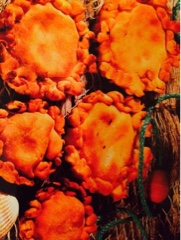
More gastronomically, perhaps, I turn to one of its local specialities - La Tielle de Sète. A kind of orange pastry, looking like a crab, and filled with octopus and tomato. My father reminded me of them the other day when he sent a postcard from nearby - we have been going to Sète since the 1980s - with a photograph of half a dozen and a recipe for the same. He had written "Yuk (I think)" on the back. My father does not like octopus.
I cannot find an English translation of "Tielle", only references to this dish - more commonly named La Tielle Sétoise - with the accent changed from a grave to an acute. There is probably a linguistic term for that but this is a piece about food. I also learn that Tielle is based on the Italian Tiella di Gaeta, Tiella meaning "pan" and the whole dish being prepared like a "pocket sandwich", whatever that might be. They look a little like pockets, I suppose, so that is what I shall call them. Sétoise, incidentally, I perceive as a sauce with tomatoes, chilli and onion: orange-looking, exactly like these "tielles" in fact.
Here is the wording on the original postcard, followed by my attempt at a translation.
La Tielle de Sète
(Pour 6 personnes)
Prendre 1 kg de poulpes, les nettoyer et les plonger dans un court bouillon. Faire blondir 200 g d'oignons dans un peu d'huile avec 2 gousses d'ail, 1 brin de persil et du concentré de tomates, ajouter du vin blanc, du sel, du poivre.
Faire cuire quelques minutes. Puis ajouter les poulpes apres les avoir coupés, du laurier, un peu de piment et laisser cuire 20 mn.
Pendant ce temps préparer une pâte à pain avec 1 kg de farine, de l'eau et de la levure. Mettre la pâte dans une moule, garni avec la farce et recouvrir du reste de pâte en formant un couvercle en le soudant avec de l'eau bien hermétiquement. Badigeonner d'huile et laisser cuire 15 mn à 20 mn thermostat 7°.
POCKETS FROM SÈTE
(Serves 6)
Take one kilo of octopus, clean and immerse in a "court bouillon". Sauté 200 g of onions in a little oil with two cloves of garlic, one sprig of parsley and some tomato purée; add white wine, salt and pepper.
Cook for a few minutes. Then add the octopus having cut it, with bay leaf and a sprinkle of pepper and cook for twenty minutes.
Meanwhile, prepare a bread dough with one kilo of flour, water and yeast. Put the dough in a pan, top with the octopus mixture and cover with the remaining dough, forming a cover by sealing with water.
Brush with oil and cook for fifteen to twenty minutes at gas mark 7.
Take one kilo of octopus, clean and immerse in a "court bouillon". Sauté 200 g of onions in a little oil with two cloves of garlic, one sprig of parsley and some tomato purée; add white wine, salt and pepper.
Cook for a few minutes. Then add the octopus having cut it, with bay leaf and a sprinkle of pepper and cook for twenty minutes.
Meanwhile, prepare a bread dough with one kilo of flour, water and yeast. Put the dough in a pan, top with the octopus mixture and cover with the remaining dough, forming a cover by sealing with water.
Brush with oil and cook for fifteen to twenty minutes at gas mark 7.
Monday, 4 May 2015
Brian's cucumber pickle
Unlike most pickles, you can eat this immediately and with nothing other than a spoon.
INGREDIENTS
2 lb cucumbers
2 large onions
1 large green pepper
2oz salt
For the syrup:
3/4 pt cider or wine vinegar
12 oz soft brown sugar
1/2 level teaspoon ground turmeric
1/4 level teaspoon ground cloves
1 level dessert spoon mustard seed
1/2 level teaspoon celery seed
Bri says if you haven't got these, fudge with what you have.
Wash cucumbers. Do not peel. Slice thinly.
Slice onions, shred the green pepper.
Put them in large mixing basin with the salt.
Mix well. Cover with weighted plate and stand for 3 hours.
Rinse thoroughly under cold running water in colander.
Drain well and place in large saucepan.
Add vineger.
Bring to boil. Simmer gently until soft, about 20 mins.
Add sugar and spices to pan. Stir over low heat to dissolve sugar.
Bring to boil. Draw off the heat. Turn into large mixing basin. Set aside until cold.
Pot.
INGREDIENTS
2 lb cucumbers
2 large onions
1 large green pepper
2oz salt
For the syrup:
3/4 pt cider or wine vinegar
12 oz soft brown sugar
1/2 level teaspoon ground turmeric
1/4 level teaspoon ground cloves
1 level dessert spoon mustard seed
1/2 level teaspoon celery seed
Bri says if you haven't got these, fudge with what you have.
Wash cucumbers. Do not peel. Slice thinly.
Slice onions, shred the green pepper.
Put them in large mixing basin with the salt.
Mix well. Cover with weighted plate and stand for 3 hours.
Rinse thoroughly under cold running water in colander.
Drain well and place in large saucepan.
Add vineger.
Bring to boil. Simmer gently until soft, about 20 mins.
Add sugar and spices to pan. Stir over low heat to dissolve sugar.
Bring to boil. Draw off the heat. Turn into large mixing basin. Set aside until cold.
Pot.
ENJOY.

Wednesday, 3 December 2014
Catalan breakfast
Whether this is an authentic term for what you see below I do not know: but it is what I use. The components are light pieces of toast, olive oil, tomatoes well-salted and peppered and Serrano ham. You squash the tomatoes into the oil with the toast and then alternate between eating tomato, ham on the toast - or even both. It is a good plan to leave enough toast at the end to mop up the juices at the end...or make more toast.

Sunday, 16 November 2014
Simple roast chicken
I love chicken with all the trimmings - and at some point I must find out why the word "trimmings" is used to refer collectively to things like bread sauce, sage stuffing and pigs in blankets. But the apparent effort of producing these extra things, delicious though they are, I think puts us off having roast chicken on a week night.
Here, then, are my views about three essential ingredients to add to your plump raw chicken: plenty of salt rubbed into the skin; butter ditto; and a lemon stuffed inside. If I were allowed a fourth ingredient, it would be twigs of thyme, tarragon or rosemary, tucked all over the bird. (I am wondering while I write this whether an onion could also be fitted inside, and black pepper ground over the skin: enough!)
After five minutes' preparation, the chicken can then be put in the oven. Mashed potato and green peas to accompany the bird. A quick gravy can be made from the buttery, lemony juices.
Tuesday, 30 September 2014
Chilled soup
I recently received a marketing e-mail from Waitrose which included the headline "An exclusive 25% off chilled soups". Below, it read: "Soup is the perfect comfort food to cheer up a chilly autumn day. That's why we're offering myWaitrose members 25% off all chilled soups until 7 October". Apart from the flawed logic, it is the misuse of "chilled" to which I object. Presumably, they are referring to soup which is served hot but sold from their refrigerators rather than in a tin or a packet. But to me "chilled soup" conjures up Gazpacho and Vichyssoise - perfect Summer soups but not, I suspect, what the marketeers had in mind. As a matter of fact, I'll happily eat Gazpacho all year round: and, in fairness to Waitrose, having criticised their use of language, they are the only supermarket in the land which sell Gazpacho (Alvalle is the brand) that bears any resemblance to what you can get in Spain.
My uncle Alex has a novel way if Gazpacho is ever on the menu at any dinner party he attends. He asks for it to be put in the microwave. Cold soup, in his view, is unacceptable.
In my mother's recipe book is a recipe for "Strawberry Gazpacho". I reproduce it below:
1/2 lb strawberries
1 teaspoon tabasco
1 tin beef consommé
1/4 pint orange juice
2 cucumbers
Salt and pepper
Blend in food processor.
I have not tried it, and must confess I would feel slightly wary about doing so. Beef consommé and orange juice? Hmmm.
There is a further recipe for another chilled soup on the same page:
Beetroot consommé
Boil pieces of raw beetroot, carrots, onions, potato and stock cube. Make up with one packet of Madeira aspic. Serve chilled with sour cream.
My uncle Alex has a novel way if Gazpacho is ever on the menu at any dinner party he attends. He asks for it to be put in the microwave. Cold soup, in his view, is unacceptable.
In my mother's recipe book is a recipe for "Strawberry Gazpacho". I reproduce it below:
1/2 lb strawberries
1 teaspoon tabasco
1 tin beef consommé
1/4 pint orange juice
2 cucumbers
Salt and pepper
Blend in food processor.
I have not tried it, and must confess I would feel slightly wary about doing so. Beef consommé and orange juice? Hmmm.
There is a further recipe for another chilled soup on the same page:
Beetroot consommé
Boil pieces of raw beetroot, carrots, onions, potato and stock cube. Make up with one packet of Madeira aspic. Serve chilled with sour cream.
Sunday, 23 February 2014
Horseradish
I was so used to seeing this come out of a jar, a little slimily (and usually served with grey rather than red beef), that I never realised there was an actual vegetable called a horseradish, until I saw a pile of them in Fortnum & Mason's one Christmas Eve. As we were planning to have roast beef on Christmas Day, it was the perfect find. So the horseradish was bought, and when it was bought it was wrapped and went into my brother's stocking. As I expected him to do, he made an obscene remark on discovering it. On Christmas morning, I allocated to myself the task of turning it into horseradish sauce. And very quickly, I realised why it was that most people acquired their horseradish sauce from a jar rather than making it from scratch. Grating it was worse than chopping an onion. But, having finished making it, I very quickly realised why it was WORTH making it from scratch. It actually tastes fresh and alive. Hugh Fearnley-Whittingstall is responsible for this recipe, which comes in his River Cottage Meat Book: the best book on the subject that I know.
100 g horseradish
125 g creme fraiche
1 teaspoon English mustard
2 teaspoons wine vinegar
Pinch sugar
Salt and pepper
Peel and grate horseradish. This is the toughest bit. Then steep the horseradish in the vinegar, mustard and sugar for ten minutes. Stir again. Add the creme fraiche and mix it together well. Add salt and pepper if and as necessary.
Monday, 29 April 2013
Tequila
A thirtieth birthday party when Tequila shots were brought round reminded me of an occasion many years ago (in fact in about the year the birthday girl was born) when my parents entertained a Mexican at our house in East Dulwich.
I have no idea how he ended up staying with us but he brought with him a bottle of Tequila and gave us a lesson in how to drink it. We were all assured that his was the authentic way. There were the three stages. A pinch of salt on the bridge between the thumb and the index finger to lick, a swig (no shot glasses!) of the Tequila, and finally a sip of tomato juice from a separate glass. Somewhat extraordinarily, I was permitted to participate. Personally, my favourite bit was the salt and lemon juice.
Since then, I have never seen anyone drink Tequila in that fashion. Instead the form appears to be to start with unadulterated salt, then to down a shot of Tequila and finally to suck on a lemon slice. That was how we did it at Katy's thirtieth, anyhow. One of the deleted scenes from "The Office" involved an interesting variation on this theme in which the lemon slice was held between somebody else's teeth.
I have no idea how he ended up staying with us but he brought with him a bottle of Tequila and gave us a lesson in how to drink it. We were all assured that his was the authentic way. There were the three stages. A pinch of salt on the bridge between the thumb and the index finger to lick, a swig (no shot glasses!) of the Tequila, and finally a sip of tomato juice from a separate glass. Somewhat extraordinarily, I was permitted to participate. Personally, my favourite bit was the salt and lemon juice.
Since then, I have never seen anyone drink Tequila in that fashion. Instead the form appears to be to start with unadulterated salt, then to down a shot of Tequila and finally to suck on a lemon slice. That was how we did it at Katy's thirtieth, anyhow. One of the deleted scenes from "The Office" involved an interesting variation on this theme in which the lemon slice was held between somebody else's teeth.
Thursday, 3 January 2013
Mashed potato
It is odd how something so simple can on occasions be so utterly revolting. Take Smash: dried mashed potato in a packet. The most successful advertising I've ever experienced, judging by the distance between the advert and reality. The description of the carefully selected, beautifully peeled and prepared potato... What on earth was my mother thinking of when she bought it? Perhaps I inveigled her. The finished result was utterly lacking in flavour, texture or integrity.
Another thought that occurs to me, this time in relation to school mashed potato. How was it that it was so nasty yet in different ways depending on the day it was served? And how could the powers that be have decreed that it ever be served with salad (Monday lunches)?
Here is how to make mashed potato that sings. Peel, chop into small pieces and boil your potatoes. Meanwhile, cut a small onion as finely as you can. When the potatoes are cooked, drain them, then throw in the onion, a large lump of unsalted butter, a glug of double cream, some salt crystals and freshly ground black pepper and mash away furiously. I use a potato ricer.
As you'll have gathered, this is not one of those recipes where precision in terms of quantities is required. What is necessary is thorough mashing and heat.
A final observation. "Mustard mash" is something you often now find in the kind of pub that serves lamb shank. It is my theory that potatoes and mustard do not go together. However, I have no difficulty with a dab of mustard on the side to go with the sausages that so often accompany mash: though it was only in the "Dandy" that they were ever stuck into the mash, as a feast for Tom Tum or Greedy Pigg.

Another thought that occurs to me, this time in relation to school mashed potato. How was it that it was so nasty yet in different ways depending on the day it was served? And how could the powers that be have decreed that it ever be served with salad (Monday lunches)?
Here is how to make mashed potato that sings. Peel, chop into small pieces and boil your potatoes. Meanwhile, cut a small onion as finely as you can. When the potatoes are cooked, drain them, then throw in the onion, a large lump of unsalted butter, a glug of double cream, some salt crystals and freshly ground black pepper and mash away furiously. I use a potato ricer.
As you'll have gathered, this is not one of those recipes where precision in terms of quantities is required. What is necessary is thorough mashing and heat.
A final observation. "Mustard mash" is something you often now find in the kind of pub that serves lamb shank. It is my theory that potatoes and mustard do not go together. However, I have no difficulty with a dab of mustard on the side to go with the sausages that so often accompany mash: though it was only in the "Dandy" that they were ever stuck into the mash, as a feast for Tom Tum or Greedy Pigg.
Wednesday, 2 January 2013
Gravlax
This recipe comes from my mother's own recipe book. It was two years ago to the day that she died and this was one of the things she would always make at Christmastime when "Turn the gravlax!" became a twice-daily used expression, whether as a command or an intention.
Since then, making the Christmas Gravlax has been my brother Will's task. The photograph is of a plate of his, from Christmas just past.
I think it must have been Lotta, the family au pair and still dear friend, from Sweden, who stayed with us in 1982 - 1983, who introduced her and us to it. Sometimes I see it in recipe books written as "Gravadlax", sometimes as "Gravlax". Mum's recipe, then, exactly as she wrote it down, but whether this is from her head or copied from a Swedish recipe book, I am not sure. The last line (plainly her own view) was clearly added much later.
2 1/2 lb salmon trout,
20 peppercorns,
6 tablespoons salt,
4 tablespoons sugar,
2 oz dill leaves (chopped) (fresh if poss).
For sauce:
3 tablespoons French mustard,
1 tablespoon red wine vinegar,
3 tablespoons oil,
salt, pepper and sugar to taste,
3 tabespoons finely chopped dill leaves.
Split fish in two and bone. Crush pepper corns, mix with salt, sugar and dill. Sprinkle third into dish. Lay on a fillet of fish, skin side down; spread another third of dry marinade, cover with remaining fillet skin side up and pack remaining marinade over and around. Cover with cling film and weight. Leave in fridge or cool place for 36 - 48 hours turning every 12 hours. Will keep one week in fridge.
When fish has completed marinating, will be surrounded by liquid. Drain fish and scrape any solids left from marinade away. Cut horinzontally into wafer thin slices. Fold into pretty curves on serving dish. Serve with rye bread, lemon wedges and mustard and dill sauce.
Don't bother about peppercorns or sauce! Serve with lemon segments.

Since then, making the Christmas Gravlax has been my brother Will's task. The photograph is of a plate of his, from Christmas just past.
I think it must have been Lotta, the family au pair and still dear friend, from Sweden, who stayed with us in 1982 - 1983, who introduced her and us to it. Sometimes I see it in recipe books written as "Gravadlax", sometimes as "Gravlax". Mum's recipe, then, exactly as she wrote it down, but whether this is from her head or copied from a Swedish recipe book, I am not sure. The last line (plainly her own view) was clearly added much later.
2 1/2 lb salmon trout,
20 peppercorns,
6 tablespoons salt,
4 tablespoons sugar,
2 oz dill leaves (chopped) (fresh if poss).
For sauce:
3 tablespoons French mustard,
1 tablespoon red wine vinegar,
3 tablespoons oil,
salt, pepper and sugar to taste,
3 tabespoons finely chopped dill leaves.
Split fish in two and bone. Crush pepper corns, mix with salt, sugar and dill. Sprinkle third into dish. Lay on a fillet of fish, skin side down; spread another third of dry marinade, cover with remaining fillet skin side up and pack remaining marinade over and around. Cover with cling film and weight. Leave in fridge or cool place for 36 - 48 hours turning every 12 hours. Will keep one week in fridge.
When fish has completed marinating, will be surrounded by liquid. Drain fish and scrape any solids left from marinade away. Cut horinzontally into wafer thin slices. Fold into pretty curves on serving dish. Serve with rye bread, lemon wedges and mustard and dill sauce.
Don't bother about peppercorns or sauce! Serve with lemon segments.
Saturday, 1 December 2012
Rosemary bread
A sliced baguette. Rosemary from the front garden. Olive oil. Salt. And in the oven. Dedicated to Granny.
Saturday, 24 November 2012
Pumpkin soup
I am particularly fond of the word pumpkin (two plosives plus diminutive kin). I also love the look of a pumpkin or, better still, a heap of pumpkins, like the one outside Hagrid's hut in "Harry Potter and the Prisoner of Azkaban". To eat by itself, however, the pumpkin is a bland, slightly stringy, wet vegetable. To turn it from a sandy flavourless soup into a velvety soup worth eating on a cold night demands onion, curry powder, cream and time. There are probably those who would disagree, do without the curry powder or make a pumpkin pie instead.
Ingredients:
2 oz butter.
1 onion, finely-chopped.
2 tablespoons Bolst's Curry Powder (or whatever you prefer).
1 lb pumpkin, peeled, seeded and chopped into small dice.
3/4 lb potatoes, peeled and chopped.
1 tin chopped Italian tomatoes.
2 pints chicken stock.
1/2 pint double cream.
Salt and freshly ground black pepper.
Some chives and/or croutons if you have them.
Method:
1. Melt the butter in a large saucepan.
2. Add the onions and allow to soften for about 5 minutes.
3. Shortly afterwards, add the curry powder. Allow to cook slowly, without either burning.
4. Add the pumpkin and cook over a gentle heat for another 5 minutes.
5. Add the potatoes and stir on a low heat for about 15 minutes.
5. Add the tin of tomatoes, followed by the stock, the salt and FGBP.
6. Simmer until everything is tender (about one hour).
7. Allow to cool slightly then sieve or blend.
8. Return the soup to the pan (a few exciting scraps of unsieved soup left behind won't do any harm) and stir in the double cream.
9. Re-heat and eat. A few chives or croutons sprinkled on top are rather good.
Final thought: this is not soup to eat while watching "Halloween 3: Season of the Witch". I have, however, served this for a Halloween party. My friend Vicki Telling used the pumpkin shell to create a clever effect: my face amalgamated with Harry Potter's in a wizard's hat through which a lit candle shone. It was on the same occasion when her husband Richard Worth crept upstairs to change into his monk's outfit and came down in the dark bearing another candle. He caused quite a stir. A Tale Worth Telling.
This recipe is based on two taken from a little orange book called "Pumpkins, squashes and things......and how to cook them". Neither recipe has any curry powder to be seen. I am dedicating my version to my cousin Olivia Weiss who was born on 31 October!
Ingredients:
2 oz butter.
1 onion, finely-chopped.
2 tablespoons Bolst's Curry Powder (or whatever you prefer).
1 lb pumpkin, peeled, seeded and chopped into small dice.
3/4 lb potatoes, peeled and chopped.
1 tin chopped Italian tomatoes.
2 pints chicken stock.
1/2 pint double cream.
Salt and freshly ground black pepper.
Some chives and/or croutons if you have them.
Method:
1. Melt the butter in a large saucepan.
2. Add the onions and allow to soften for about 5 minutes.
3. Shortly afterwards, add the curry powder. Allow to cook slowly, without either burning.
4. Add the pumpkin and cook over a gentle heat for another 5 minutes.
5. Add the potatoes and stir on a low heat for about 15 minutes.
5. Add the tin of tomatoes, followed by the stock, the salt and FGBP.
6. Simmer until everything is tender (about one hour).
7. Allow to cool slightly then sieve or blend.
8. Return the soup to the pan (a few exciting scraps of unsieved soup left behind won't do any harm) and stir in the double cream.
9. Re-heat and eat. A few chives or croutons sprinkled on top are rather good.
Final thought: this is not soup to eat while watching "Halloween 3: Season of the Witch". I have, however, served this for a Halloween party. My friend Vicki Telling used the pumpkin shell to create a clever effect: my face amalgamated with Harry Potter's in a wizard's hat through which a lit candle shone. It was on the same occasion when her husband Richard Worth crept upstairs to change into his monk's outfit and came down in the dark bearing another candle. He caused quite a stir. A Tale Worth Telling.
This recipe is based on two taken from a little orange book called "Pumpkins, squashes and things......and how to cook them". Neither recipe has any curry powder to be seen. I am dedicating my version to my cousin Olivia Weiss who was born on 31 October!
Monday, 5 November 2012
Making salt
In about September 1981, I began studying Chemistry at school as a separate subject. My career as a chemist was to come to an ignominious end four years later when I dropped the subject, having achieved the distinction of the lowest mark in the exams in the entire school year.
But I still remember aspects of the subject with affection. Burning magnesium! My white shirt being turned into a chromatogram by some clever idiot in the desk behind me, using ink, a pipette and surgical spirit or similar. Best of all, in that very first lesson in 1981, we made salt.
The process involved dissolving a pile of what looked like sand in water, heating the water (Bunsen burner) and then - can't remember the detail but I think filter paper may have been involved somewhere - ending up with a small and rather damp pile of salt.
Very satisfyingly, we were allowed to take the results of our experiment into the dining hall to have with our lunch. Monday lunches were particularly dispiriting: salad, so-called. The salt improved the undressed lettuce and slab of pork pie.
It may have been on the same occasion that I was required by the prefect in charge of the table (I shall name and shame him: Jonathan Harding) to eat my pork pie jelly, a feat I managed only by melting it into the barely warm mashed potato on my plate.
But I still remember aspects of the subject with affection. Burning magnesium! My white shirt being turned into a chromatogram by some clever idiot in the desk behind me, using ink, a pipette and surgical spirit or similar. Best of all, in that very first lesson in 1981, we made salt.
The process involved dissolving a pile of what looked like sand in water, heating the water (Bunsen burner) and then - can't remember the detail but I think filter paper may have been involved somewhere - ending up with a small and rather damp pile of salt.
Very satisfyingly, we were allowed to take the results of our experiment into the dining hall to have with our lunch. Monday lunches were particularly dispiriting: salad, so-called. The salt improved the undressed lettuce and slab of pork pie.
It may have been on the same occasion that I was required by the prefect in charge of the table (I shall name and shame him: Jonathan Harding) to eat my pork pie jelly, a feat I managed only by melting it into the barely warm mashed potato on my plate.
Sunday, 28 October 2012
Avocado puree
My recipe book; Mum's handwriting.
Avocado puree (Mum's "nicer than guac.")
1 soft avocado, 1/2 finely chopped onion, salt, pepper, tabasco to taste and a glug of olive oil.
Mash avocado, mix in other ingreedience.
Some commentary. Simple. The final word of the recipe demands further explanation, which will be for another day.
Avocado puree (Mum's "nicer than guac.")
1 soft avocado, 1/2 finely chopped onion, salt, pepper, tabasco to taste and a glug of olive oil.
Mash avocado, mix in other ingreedience.
Some commentary. Simple. The final word of the recipe demands further explanation, which will be for another day.
Lemon pickle (2)
A second attempt. See the previous entry for what this is NOT.
The following recipe is about as simple as recipes get - that is, in terms of ingredients: lemons and salt. BUT it is relatively time-consuming to get it right, and I don't recommend cutting corners.
You also need a large chopping board, a sharp knife (kitchen devil, serrated is what I recommend) and one of those large storage jars with a lever and a rubber seal.
Here are the steps. You need about six lemons to make this worthwhile but there is no reason for not adding more lemons (and salt) if you decide to make vast amounts of this. No need to double quantities; just a lemon, a couple of lemons...etc.
The following recipe is about as simple as recipes get - that is, in terms of ingredients: lemons and salt. BUT it is relatively time-consuming to get it right, and I don't recommend cutting corners.
You also need a large chopping board, a sharp knife (kitchen devil, serrated is what I recommend) and one of those large storage jars with a lever and a rubber seal.
Here are the steps. You need about six lemons to make this worthwhile but there is no reason for not adding more lemons (and salt) if you decide to make vast amounts of this. No need to double quantities; just a lemon, a couple of lemons...etc.
15 lemons will slightly overfill a 1.5 litre jar. So maybe that’s about right.
First, wash your lemons, then set one aside.
With each lemon (except for the one set aside), slice off the very ends, then chop it into quarters.
Remove all the pips. This is absolutely essential because if you don't, they will end up as bits of sliminess in your pickle.
Having removed the pips, get the lemons into even smaller pieces. Sixteenths or even thirty-seconds - but no need to be exact. Chop the lemon as though you were chopping an onion finely. Check for stray pips as you go along.
So you will end up with a pile of bits of lemon, peel and everything, on your chopping board.
When you finish chopping each lemon, tip it into your storage jar, scraping all the lemony stuff off the board into the jar, then add a layer of salt (table salt, not salt crystals).
Stir the whole mixture around and start work on the next lemon, repeating the above process.
The final step involves the lemon that you have NOT so far chopped.
Halve it and then juice it, ideally using one of those glass juicer things, because, again, the pips are definitely not wanted.
Pour the juice into the jar, then chop the squeezed lemon halves into similar sizes to the rest of the lemons already in the jar and add them.
Add some more salt and give it a stir.
Then put the lid on, label the jar with the date and put in the fridge.
Now it's a waiting game. Check the pickle about once a week. Stir it. May be worth adding more lemon juice if it's a little dry. Possibly even a little more salt.
Worth eating after about a month and it lasts indefinitely.
Mum once tried adding the remains of some Patak's lime pickle to it which chillified it but I was not convinced...
This is the only pickle I know that really can be eaten with just about anything: Shepherd's pie, casserole of any kind. "Can't go wrong", as my mother would say.
First, wash your lemons, then set one aside.
With each lemon (except for the one set aside), slice off the very ends, then chop it into quarters.
Remove all the pips. This is absolutely essential because if you don't, they will end up as bits of sliminess in your pickle.
Having removed the pips, get the lemons into even smaller pieces. Sixteenths or even thirty-seconds - but no need to be exact. Chop the lemon as though you were chopping an onion finely. Check for stray pips as you go along.
So you will end up with a pile of bits of lemon, peel and everything, on your chopping board.
When you finish chopping each lemon, tip it into your storage jar, scraping all the lemony stuff off the board into the jar, then add a layer of salt (table salt, not salt crystals).
Stir the whole mixture around and start work on the next lemon, repeating the above process.
The final step involves the lemon that you have NOT so far chopped.
Halve it and then juice it, ideally using one of those glass juicer things, because, again, the pips are definitely not wanted.
Pour the juice into the jar, then chop the squeezed lemon halves into similar sizes to the rest of the lemons already in the jar and add them.
Add some more salt and give it a stir.
Then put the lid on, label the jar with the date and put in the fridge.
Now it's a waiting game. Check the pickle about once a week. Stir it. May be worth adding more lemon juice if it's a little dry. Possibly even a little more salt.
Worth eating after about a month and it lasts indefinitely.
Mum once tried adding the remains of some Patak's lime pickle to it which chillified it but I was not convinced...
This is the only pickle I know that really can be eaten with just about anything: Shepherd's pie, casserole of any kind. "Can't go wrong", as my mother would say.
Sunday, 21 October 2012
Introduction to Salty Food
Let me do some explaining. So far, two potato recipes, each taken from a family recipe book. Potatoes are not going to be the theme although I will almost certainly return to them. Nor is everything going to have salt in it, despite the title.
The purpose of all this is to try to pull together a collection of family recipes, photographs, and memories of family celebrations. It is, among other things, an amalgamation of three unfinished books. First, my own recipe book. Then there is my mother's, a book known as the “Foster Family Cook Book” for as long as I can remember. And finally, my mother's "Christmas Book" which, as well as Christmases past, includes accounts of other celebrations. There are other scraps from diaries, letters, photographs and other bits and pieces that would otherwise get lost or buried. As Philip Pullman wrote in "Lyra's Oxford" (2003): "The world is full of things like that: old postcards, theatre programmes, leaflets about bomb-proofing your cellar, greetings cards, photograph albums, holiday brochures, instruction booklets for machine tools, maps, catalogues, railway timetables, menu cards from long-gone cruise liners - all kinds of things that once served a real and usefu purpose, but have now become cut adrift from the things and the people they relate to."
Among other things, I am trying to capture some of my mother’s main principles when cooking and eating. She often referred to “good, honest food”: a term first used, I think, by Elizabeth David. Certainly Elizabeth David says the following in an article called 'Eating out in Provincial France 1965 - 1977': "The food was good honest food, honestly cooked". That lengthily-titled article is reprinted in "An Omelette and a Glass of Wine", possibly the greatest ever anthology of writing about food.
"Peasant food" was another favourite descriptor of my mother's: always a compliment. At more than one family supper, we would have something slightly unusual on our plates and would be told it was a staple in China or wherever. On such occasions, my father was known to say, rather plaintively, "But we're not in China".
Many years ago, at my mother's dictation, I started to make some notes on a pad of paper for a cookery book that one day she was going to write. The paper I was using, which must have been lying around at the time, advertised a Glucometer: something for diabetics to measure blood sugar? The book never materialised but the notes, mainly consisting of a list of recipes, remain.
Under the heading "Intro", the notes read as follows:
"Parents grew up in post-war Britain. Rationing. People starved of flavours and colours. Soho. Peppers in triumph. Crisp food."
The "Peppers in triumph" reference is particularly resonant. It relates to my grandfather, Roberto, who came over to England in the 1930s from Milan and married my grandmother, Eve. He would apparently visit Soho (he was a Professor of Italian at University College, London) and return home to Henley bearing peppers: Waitrose in Henley had yet to be built. The peppers would be fried in olive oil and eaten - by him alone, I am told.
The purpose of all this is to try to pull together a collection of family recipes, photographs, and memories of family celebrations. It is, among other things, an amalgamation of three unfinished books. First, my own recipe book. Then there is my mother's, a book known as the “Foster Family Cook Book” for as long as I can remember. And finally, my mother's "Christmas Book" which, as well as Christmases past, includes accounts of other celebrations. There are other scraps from diaries, letters, photographs and other bits and pieces that would otherwise get lost or buried. As Philip Pullman wrote in "Lyra's Oxford" (2003): "The world is full of things like that: old postcards, theatre programmes, leaflets about bomb-proofing your cellar, greetings cards, photograph albums, holiday brochures, instruction booklets for machine tools, maps, catalogues, railway timetables, menu cards from long-gone cruise liners - all kinds of things that once served a real and usefu purpose, but have now become cut adrift from the things and the people they relate to."
Among other things, I am trying to capture some of my mother’s main principles when cooking and eating. She often referred to “good, honest food”: a term first used, I think, by Elizabeth David. Certainly Elizabeth David says the following in an article called 'Eating out in Provincial France 1965 - 1977': "The food was good honest food, honestly cooked". That lengthily-titled article is reprinted in "An Omelette and a Glass of Wine", possibly the greatest ever anthology of writing about food.
"Peasant food" was another favourite descriptor of my mother's: always a compliment. At more than one family supper, we would have something slightly unusual on our plates and would be told it was a staple in China or wherever. On such occasions, my father was known to say, rather plaintively, "But we're not in China".
Many years ago, at my mother's dictation, I started to make some notes on a pad of paper for a cookery book that one day she was going to write. The paper I was using, which must have been lying around at the time, advertised a Glucometer: something for diabetics to measure blood sugar? The book never materialised but the notes, mainly consisting of a list of recipes, remain.
Under the heading "Intro", the notes read as follows:
"Parents grew up in post-war Britain. Rationing. People starved of flavours and colours. Soho. Peppers in triumph. Crisp food."
The "Peppers in triumph" reference is particularly resonant. It relates to my grandfather, Roberto, who came over to England in the 1930s from Milan and married my grandmother, Eve. He would apparently visit Soho (he was a Professor of Italian at University College, London) and return home to Henley bearing peppers: Waitrose in Henley had yet to be built. The peppers would be fried in olive oil and eaten - by him alone, I am told.
Subscribe to:
Posts (Atom)